
The Elements of a Great Project
Hello, I assume you are reading this because you have a project of some kind and don’t know how to begin. Relax! There are a lot of ideas for projects out there. Everyone has an idea… or ten. It’s easy to dream right? Ask me about my list of desired home improvements. Hide your phone from yourself for 10 minutes and read this through, there’s a good chance something here will help you.
Few ideas ever become realities, and even most good ideas will remain only as ideas. Many ideas lack in key areas; the tangible strength to move forward and become actual projects, the leadership to develop them, and the willpower that comes with stakeholder buy-in. Most idea-havers suspect missing ingredients, but what? By far, most often the the biggest perceived barrier keeping an idea from becoming a project is money. When I lend a hand to a client to work on a project, I frequently see this dynamic. However, successful projects are ones which have matured beyond the idea phase, with additional consideration for multiple project elements which elevate the idea into a full-blown project. Money is always important, but its frequently not the first issue. Oftentimes projects come in the form of infrastructure construction, but not always. Using a basic project development model can also help with internal restructuring, software development, or even event planning.
What are these elements? There are many theories of project development and each project is different, here is a good one from VDOT. But don’t be frightened by complex models, I think of effective project development as the following: Concept, Feasibility, Planning, Design, QAQC, and Management. I’ll explain what I mean with this list and what advantages and disadvantages this method has over other methods (or no method at all). Think of them like a chain than pulls your project forward.

Project Element Chain
CONCEPT
A concept for a project is the same as having the idea. Ideas are fun and exciting, but these emotions sometimes distract from the important work of developing a strong project concept. One of the most important things to think about at this stage are the needs the project is supposed to address. People can’t cross the river, you need a bridge. People can’t collect data adequately, you may need a new tool, or new software. In exploring the needs for a project, it may be helpful to deploy another useful tactic called the Five Whys. I’m not going to cover that in depth here, but it challenges the thinker to dig deeper when exploring needs. Why do people need to cross the river? It could be because half the town is on the other side, or it could be because one guy likes to fish on the opposite bank. Those results could led to massively different bridges, or possibly no bridge at all. Digging down into the levels of need reveal a project which could be much different than first expected. Using the Five Why’s is a skill you develop, once you have done it a few times it gets much easier.
FEASIBILITY
Sometimes there is no clear transition from Concept to Feasibility because the latter is a more formal extension of the former, however, examining the Feasibility adds new components to the mix. If you haven’t already identified your key stakeholders during the concept development stage, now is the time to find them and loop them in, this may include public meetings or presentations depending on your project. In some cases when the project is more complicated or has a lot of stakeholders, a feasibility study is highly recommended. Costs for studies like these can vary wildly, but it’s almost always a good idea to spend a little money at the beginning of a project to avoid major costs in later stages. More advanced studies may include preliminary estimates, ideally from engineers if needed, that can set realistic expectations for a project. Thinking about the hazards related to a project (whether safety, economic, or organizational) and their related risks is also a key step to help you avoid their pitfalls later. Based on the information gathered, studies may also suggest multiple alternatives for the project, usually including at least one alternative where no action is taken (“no build”) and others which seek to limit risks in different ways (steel bridge or concrete bridge?) It’s possible that a study can suggest dividing a project up into phases of smaller projects due to various factors, or, combining with other larger ones if there is a significant nexus with another project already underway. important to remember that Feasibility Studies are not final designs, and everything is still subject to change, the important part is the major problems are identified and thought about as early as possible.
PLANNING
“Work the plan, or Plan to work”. You have probably heard this phrase from some fatherly figure in your life at one point or another, despite this, there is a real sense that spending time and effort on planning is wasteful. Most people prefer action! Lets get going! Things never go to plan anyway right? Our culture places a high value on the heroic leader figure that bravely deflects incoming problems like they were slings of arrows. A cry for flexibility! is heard, and “plans just limit our options”. Leaders also want to be seen putting out a dozen dumpster fires a day, because it makes them look highly effective. Look how capable I am! But lets just break this down for a moment.
“Work the plan”. With a strong project concept and feasibility study in the bag you’ll be surprised to know you will already avoid many of the issues you would have encountered otherwise. I can’t prove it, and I’ll never be able to, because you can’t prove things that don’t happen, but trust me, you will come out ahead. I’ll be honest with you, people think about flexibility backward. Why do we need flexibility in a plan? Not a trick question, we need it to deal with unforeseen issues, and man, in todays world there are a lot of unforeseen issues. Starting to see a feedback loop? Lack of planning creates the unforeseen issues, and in response, the flexibility we desire reduces our ability to plan. Here is where the “or Plan to work” kicks your butt. With this in mind, the wise eye can spot the projects where either: leadership is trying to look heroic, wanting you to think they alone have the ability to face the unpredictable and solve the impossible; or, leadership that wants to deliver the project successfully and move on to the next thing. See if you can spot this phenomenon for yourself.
What remains to be planned? Everything relating to this project from here on out. At this point, this thing is as real as it’s ever been, and people might be getting excited about it, but a few key questions could remain.
Now is the time to develop a budget as accurately as you can. Include the costs for the remaining work, such as design, land acquisition and management. Think about where your funding is coming from. Usually, this is where LMRS enters the conversation! Many times grants are identified to solve all the problems, but I will note we are over 900 words into this article already, and grants fall closer to the end of the process than the beginning. Most grants do not like funding design and construction together- oftentimes dividing the project into two phases is required. Sometimes grants can be used to fund other grants, this takes some thought to determine how to proceed.
Design is your next challenge. You may need to find and hire an engineer of an appropriate kind, and the design process usually takes on a life of its own so understanding the durations of these things is critical to setting expectations around project duration.
Quality Control and Governance is an area you should have already identified as a potential risk, if you haven’t considered it yet, consider it now. For larger projects, handling and documenting finances, conducting procurements and auditing deliverables will be important. Building anything from a train station to an iphone app will require contracts, meetings, and reports of many kinds, and understanding what the expectations are is a non-negotiable. Have a QAQC Plan from here on.
DESIGN
If you have made it this far, you are doing fantastic. By now you have your stakeholders involved, your funding arranged, and your plan to deliver the project essentially done. You may have an engineer working on your project, and that is exciting! Be mindful of the following:
Most grant programs require approved designs to be stamped by a licensed professional engineer. Your funding partner (Grantor) is not interested in paying for a project that could harm someone.
A licensed engineer will want to iterate the design to address as many issues as possible. Plan for at least 3 design review cycles before there are suitable, buildable, final plans. Usually this process also includes obtaining any permits which are necessary, and that can take time, so calibrate your delivery schedule to meet these needs.
Check your design standards. For buildings, there are building codes. For historic resources there may be easement rules which must be followed. For railroad projects there are design standards from AREMA and others. For trail projects AASHTO and local DOT’s issue design standards. Typically you have to build to these standards for your project to be funded.
With your design done, move on to selecting a builder for your project. Procedures for procurement and awarding of contracts vary so much from organization to organization, we are going to skip over it for now.
QUALITY CONTROL
You might be asking yourself, why is there no “Construction” or “Delivery” element? Seems strange. The way I see it is if you have gone through all these steps to get to this point, you are almost certainly hiring a contractor to deliver your project for you. Few of you reading this will do both the project planning, and bulldozer driving portions of a project. If you chose your contractor wisely, they will take all the information you have generated and make your project a reality, that’s their superpower. It should be said that contractors appreciate well-developed and well-designed projects as much as anyone else. No friends, at this point it is much more import for you to think about Quality Control. Fully implement your QAQC plan from earlier, and keep close tabs on project finances, timetables and deliverables. Update your stakeholders on current events. Provide reports to your Grantor, and your internal control structure (great link with hilarious video). Check in on your contractor, ask for documentation on materials, count stuff, do site visits, and audit invoices. A good contractor won’t be offended by this, it’s normal business operations. If your contractor sends you mixed signals about QAQC, you probably need to do more of it, not less.
MANAGEMENT
You made it, your project has been completed. They said it couldn’t be done, but you knew it just took some sensible preparation and a little- a lot of- diligence. Now, what happens to your {bridge, trail, railroad, structure, app, internal process, product, or service}? Establishing clear expectations for who operates it, maintains it, pays for repairs and responds in emergencies can be easily forgotten about, but beware, your project won’t have a long and beneficial life without this resolved. Maybe the answer to some of these questions is you, other times many it’s someone else. Believe it or not, Asset Management is such a forgotten element in project development that only in the last few years has it gotten its own term, schema and science (at least in some non-engineering circles). Make sure your partners are doing their part, and if they need help, work together to find solutions. Remember, if your project isn’t maintained, somebody will have to come back and do it over again in the future and that sounds like a lot of work!
What do you think? Email me here with your comments and feedback, or to join the LMRS mailing list to get alerts when new articles are published.
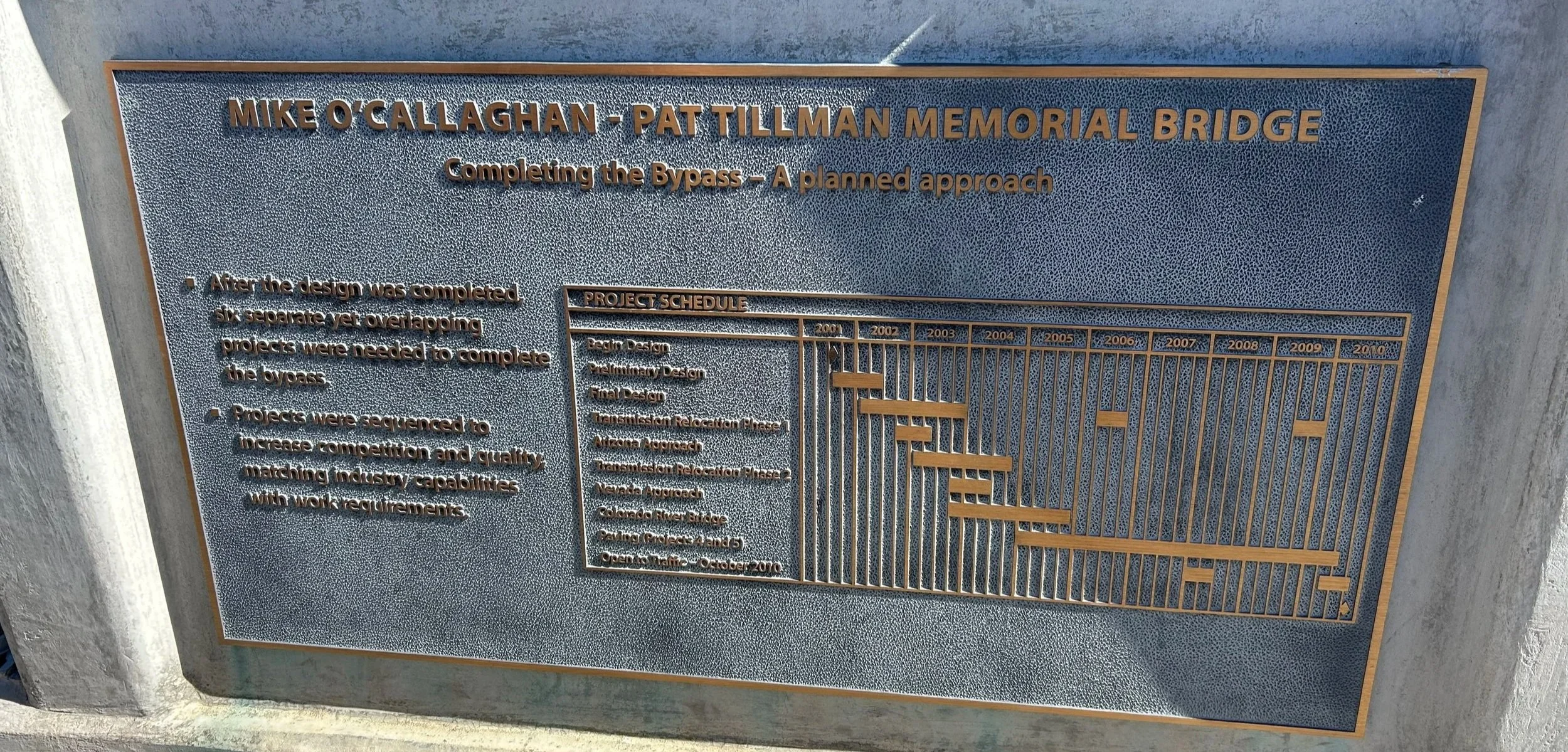
I’ll leave you with this final image. Earlier this year I visited the O’Callaghan/Tillman Memorial Bridge over the Colorado River at Hoover Dam. The planners and engineers of this project were so proud of the job they did, they cast the Gantt Chart for the project in bronze. It’s easy to say this is the nerdiest bronze plaque in existence, but it’s also true that the planning and design work on projects should probably be recognized more often.
Please pardon any spelling or grammar errors, this article was written by a person, not a processor. When you find one, think “Oh, an person is talking to me not a computer” ;)